

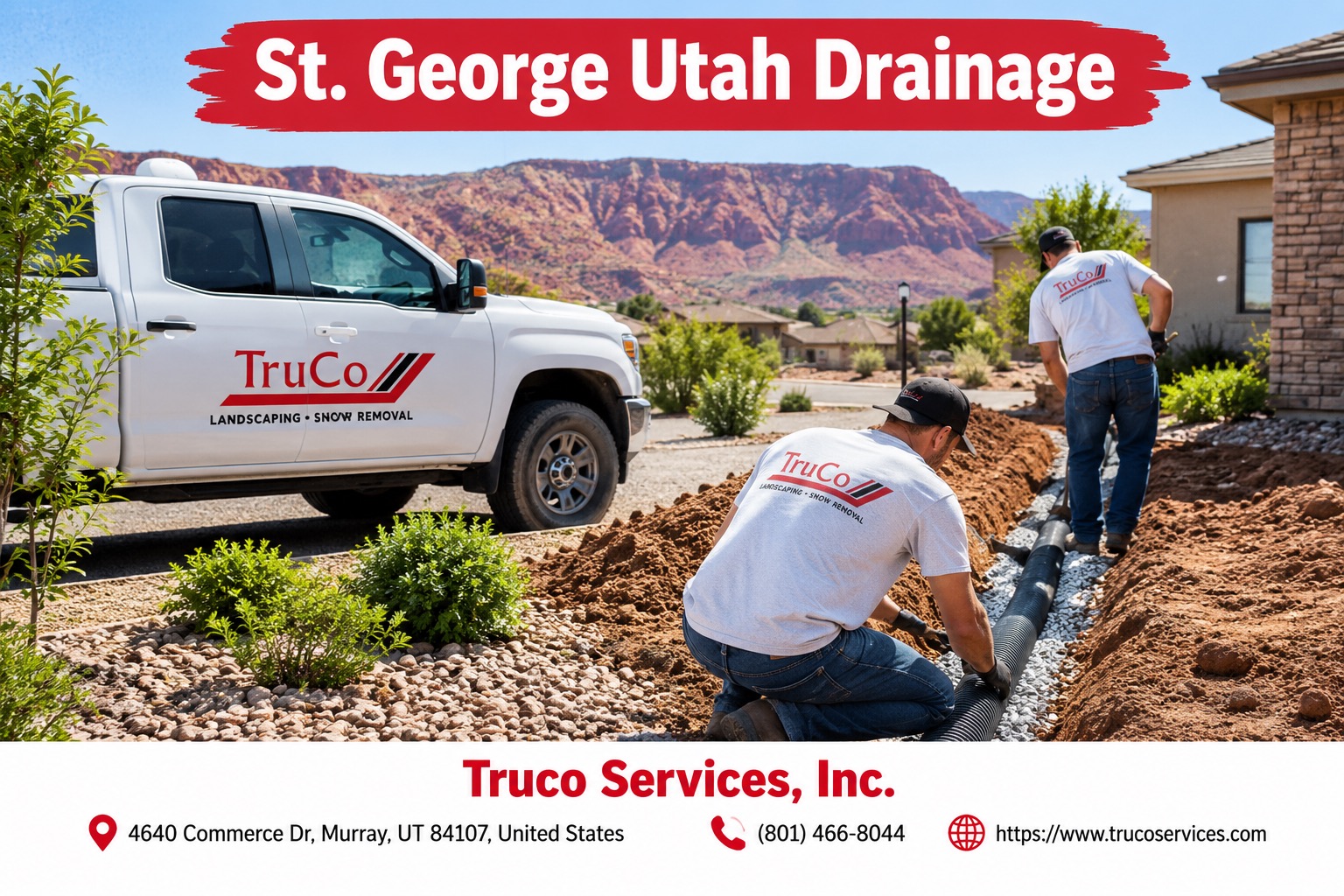
St. George Utah Drainage: Complete Guide to Landscape Drainage Solutions
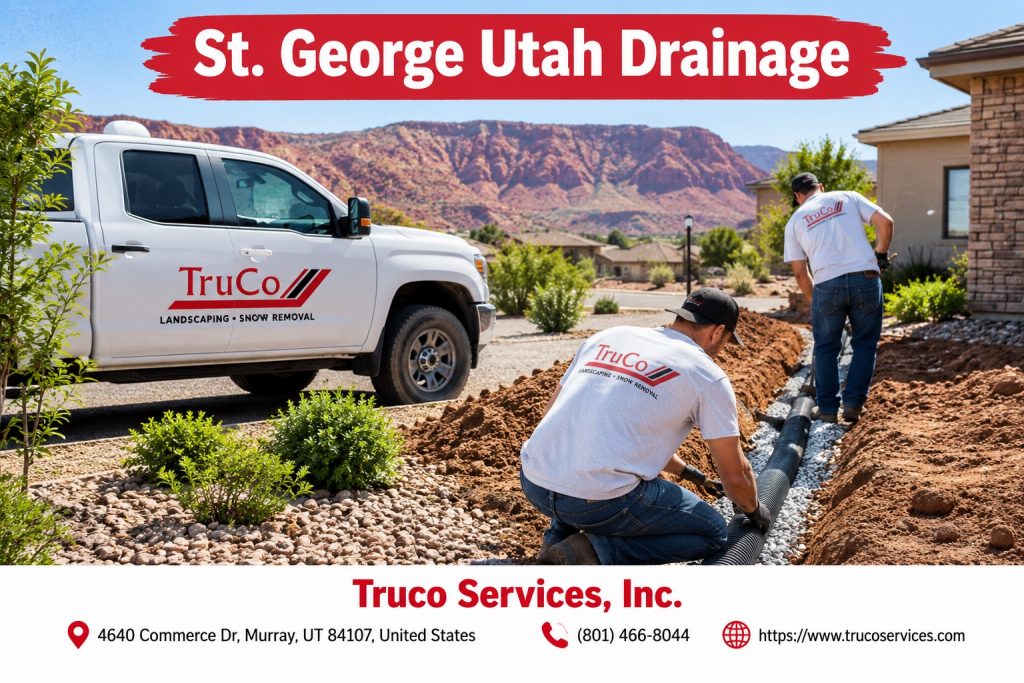
Proper drainage is one of the most important—and frequently overlooked—aspects of maintaining a healthy, attractive landscape in St. George, Utah. Although Southern Utah is known for its hot, dry climate and relatively limited rainfall, intense storms can produce substantial amounts of runoff in a short period of time. Without an effective drainage plan, water can collect around foundations, wash away soil, damage plants, erode slopes, stain hardscapes, and create costly landscape problems.
St. George Utah drainage is therefore about much more than simply moving water away from a yard. A successful drainage system should work with the property’s grading, soil conditions, landscape design, irrigation system, hardscape features, vegetation, and surrounding terrain.
For homeowners, businesses, HOAs, and property managers dealing with standing water, erosion, runoff, or poorly draining landscape areas, professional drainage planning can make a major difference. Truco Services, Inc. provides landscaping and landscape construction services that can incorporate grading, drainage, irrigation, and other elements into a coordinated outdoor-space solution.
Why Drainage Matters in St. George, Utah
St. George has a distinctive desert environment. Hot temperatures, intense sunshine, dry periods, occasional heavy precipitation, varying soil conditions, slopes, and extensive hardscape can all influence how water behaves on a property.
One of the biggest misconceptions about drainage in Southern Utah is that drainage problems are not important because the area is dry.
In reality, a dry climate can make effective drainage even more important.
When a significant storm occurs, large quantities of water may arrive over a relatively short period. If the landscape is not properly graded or drainage infrastructure is inadequate, water may have nowhere appropriate to go.
The City of St. George’s drainage guidance specifically addresses storm runoff, erosion control, floodplain considerations, and the need to prevent drainage from negatively affecting adjoining properties.
A well-designed drainage system can help direct water away from vulnerable areas while reducing erosion and protecting the landscape.
If you need related articles, see the following:
St. George Utah Landscape Patio Design
St. George Utah Creative Landscaping
St. George Utah Landscape Contractors
Common Signs Your St. George Property Has a Drainage Problem
Drainage problems are not always immediately obvious. Some issues appear only during storms, while others develop gradually over months or years.
Look for signs such as:
- Standing water in the yard
- Muddy or constantly damp areas
- Water flowing toward the house
- Water collecting beside patios
- Soil washing away after storms
- Exposed plant roots
- Mulch or decorative rock being displaced
- Erosion along slopes
- Water pooling around retaining walls
- Downspout discharge causing landscape damage
- Cracks or settlement associated with water movement
- Plants repeatedly dying in wet areas
- Excessive runoff across walkways
- Water flowing onto neighboring properties
- Landscape beds that remain saturated
- Irrigation water running off instead of soaking into the soil
A recurring problem should not simply be covered with additional soil or decorative rock. The underlying cause needs to be identified.
Understanding Landscape Drainage
Landscape drainage is the process of managing excess water so it can move through, across, or away from a property in a controlled manner.
Depending on the property, drainage may involve several components.
Grading
Grading determines the direction water naturally wants to travel.
A landscape with appropriate grades can encourage water to move away from structures and toward suitable collection or discharge points.
Poor grading can cause water to move toward:
- Homes
- Garages
- Retaining walls
- Patios
- Outdoor living spaces
- Planting beds
- Neighboring properties
Grading is especially important during new landscape construction because correcting grades before patios, walls, irrigation, planting, and other features are installed can prevent future complications.
Truco Services’ St. George landscape construction information similarly emphasizes the relationship between grading, soil preparation, irrigation, and drainage.
French Drains
A French drain is a subsurface drainage system designed to collect and redirect water.
Typically, a perforated drainage pipe is installed within a gravel-filled trench. Water enters the system and is directed toward an appropriate outlet.
French drains can potentially be useful for:
- Persistently wet landscape areas
- Water collecting along certain property boundaries
- Yard drainage problems
- Areas where surface drainage is undesirable
- Controlling subsurface water movement
The correct design depends on site conditions, elevation, available discharge locations, and applicable requirements.
Catch Basins
Catch basins collect surface water at low points.
They can be particularly useful where runoff naturally concentrates. A catch basin can connect to underground drainage piping that carries water toward an appropriate discharge location.
This approach can help reduce visible channels of water moving across lawns, planting areas, patios, or walkways.
Channel Drains
Channel drains, sometimes called trench drains, collect surface runoff along a linear area.
They can be useful near:
- Driveways
- Patios
- Walkways
- Pool areas
- Outdoor living spaces
- Sloped hardscape
Proper placement and grading are critical. A drain cannot compensate for an improperly designed overall drainage system.
Downspout Drainage
Roof runoff can contribute substantially to landscape drainage problems.
A downspout that releases concentrated water next to a foundation or planting bed can create erosion and saturation.
Depending on the property, downspout water may need to be directed through an appropriate drainage solution rather than simply discharged at the base of the building.
St. George Soil and Drainage Challenges
Soil conditions play an important role in determining how water behaves.
Some properties may drain relatively quickly, while others can have compacted or less-permeable layers that cause water to collect.
Caliche and other subsurface conditions can also influence excavation, infiltration, planting, and drainage.
This is one reason drainage solutions should not be selected solely from a list of standard products. Two properties in the same neighborhood can have very different drainage requirements.
A professional assessment should consider:
- Soil
- Existing grades
- Property slope
- Existing vegetation
- Irrigation
- Downspouts
- Hardscape
- Building location
- Retaining walls
- Neighboring properties
- Existing drainage infrastructure
- Intended water discharge location
Drainage and Irrigation Must Work Together
Drainage and irrigation are closely connected.
A landscape can have a properly installed irrigation system and still experience water problems if irrigation zones are poorly designed or watering schedules are excessive.
Conversely, a drainage system may appear ineffective when the actual problem is excessive irrigation.
Efficient landscape design can separate plants according to their water requirements. Truco Services’ Southern Utah landscaping information discusses irrigation zoning, drip irrigation, efficient emitters, and the relationship between irrigation and drainage.
This integrated approach is particularly valuable in St. George, where water conservation is an important consideration.
Drainage for Xeriscaping and Water-Wise Landscapes
Water-wise landscaping does not mean eliminating every green plant.
A well-designed xeriscape can include:
- Native and desert-adapted plants
- Trees
- Shrubs
- Groundcovers
- Carefully selected turf
- Decorative rock
- Mulch
- Patios
- Walkways
- Retaining walls
- Drip irrigation
- Strategic drainage
Drainage should be incorporated into the overall design rather than treated as an afterthought.
Truco Services’ landscape design guidance emphasizes combining drought-tolerant plants, efficient irrigation, soil preparation, drainage, hardscape, and thoughtful layout.
Drainage and Erosion Control
Water does not simply collect—it can also move soil.
Fast-moving runoff can create channels and gullies, expose roots, undermine landscape features, and redistribute decorative rock and mulch.
Erosion can become especially problematic on sloped properties.
The City of St. George’s drainage guidance requires erosion mitigation for drainage associated with new development and addresses the need to control runoff so eroded soil and debris do not enter downstream watercourses or adjoining properties.
A drainage solution should therefore consider not only where water goes, but also how quickly it moves and what it carries along the way.
Drainage Around Patios, Walkways, and Hardscapes
Hardscape changes how water behaves.
A lawn or planting bed can allow some precipitation to infiltrate the ground. A concrete patio, paver area, driveway, or other impervious surface can generate substantially more surface runoff.
When designing outdoor spaces, drainage should be considered before installation.
For example, a patio may need appropriate slope toward a drainage collection point rather than toward the home.
Likewise, walkways and retaining walls should be constructed so that water does not become trapped behind or beneath them.
Proper drainage can protect the investment made in:
- Patios
- Pavers
- Outdoor kitchens
- Fire-pit areas
- Retaining walls
- Walkways
- Driveways
- Decorative landscape features
Drainage Around Retaining Walls
Retaining walls can be particularly vulnerable to water pressure.
When water becomes trapped behind a retaining wall, hydrostatic pressure can increase. Depending on the design, drainage components may be needed to manage water behind the wall.
A drainage strategy for a retaining wall can involve appropriate aggregate, drainage piping, outlets, grading, and other construction details.
Drainage should be planned as part of the wall design rather than added only after problems appear.
Stormwater Management in St. George
Modern landscape drainage can also incorporate more sustainable approaches.
St. George’s Unified Development Code includes stormwater best-management concepts such as permeable stormwater planters. These can collect roof runoff, filter water through layered media, support plantings, and allow water to infiltrate gradually.
Depending on the property and project requirements, stormwater management may involve:
- Infiltration areas
- Stormwater planters
- Drainage channels
- Collection systems
- Detention
- Controlled discharge
- Permeable surfaces
- Landscape grading
Not every property requires the same solution. The right approach depends on the site’s physical characteristics and applicable regulations.
Why Professional Drainage Design Is Worth It
Drainage is one of those landscape components that can be easy to underestimate.
A homeowner may see standing water and assume that adding a drain in the lowest spot will solve the problem. Sometimes it might. But if the underlying grade, irrigation, soil, or discharge route is incorrect, the problem can simply move somewhere else.
Professional drainage planning can help identify the actual source of the problem.
Instead of asking only, “Where is the water pooling?”, a professional should also consider:
Where is the water coming from?
Why is it collecting here?
Where should it go?
How quickly should it move?
Will the solution create erosion?
Will the drainage affect neighboring property?
How will irrigation interact with the system?
These questions can make the difference between a temporary fix and a long-term drainage solution.
Why Call Truco Services for St. George Utah Drainage?
When you are searching for St. George Utah drainage, choosing a company capable of looking at the entire landscape—not just one drainage component—can be a major advantage.
Truco Services, Inc. is a strong choice to consider because drainage frequently intersects with other landscaping services.
1. Drainage Can Be Integrated With Landscape Construction
Drainage is often connected to grading, irrigation, planting, hardscape, and soil preparation.
Truco Services’ landscape construction approach recognizes these elements as interconnected parts of a successful landscape.
This integrated perspective can be especially valuable when drainage problems are discovered during a larger landscape renovation.
2. Experience With Southern Utah Landscaping Considerations
St. George landscaping requires attention to heat, water management, soil, plant selection, irrigation, and grading.
A drainage solution should complement these conditions rather than relying on a generic approach designed for a completely different climate.
3. Drainage and Irrigation Can Be Considered Together
Excess water is not always caused by rainfall.
Overwatering, broken irrigation components, poor sprinkler coverage, or inappropriate watering schedules can also contribute to drainage issues.
Because Truco Services works with irrigation and landscape construction, drainage can be considered alongside water delivery and landscape design.
4. Drainage Can Be Part of a Larger Landscape Improvement
Perhaps you do not simply need a drain.
You may actually need:
- Regrading
- New planting
- Irrigation improvements
- Decorative rock
- A retaining wall
- A patio redesign
- Erosion control
- Xeriscaping
- Soil preparation
- Landscape renovation
A company capable of addressing multiple components can help create a more coordinated result.
5. A Long-Term Approach Is Better Than a Quick Patch
Drainage problems can become expensive when repeatedly repaired without addressing their source.
A long-term approach considers how water moves through the entire property and how the drainage solution will interact with future landscape improvements.
When Should You Call a Drainage Professional?
Do not wait until a drainage problem causes major landscape damage.
Consider scheduling an evaluation if:
- Water repeatedly pools in your yard.
- Stormwater flows toward your home.
- Soil is washing away.
- A retaining wall shows drainage-related concerns.
- Your patio or driveway collects water.
- Plants repeatedly die from excess moisture.
- Irrigation causes runoff.
- Your landscape has significant slopes.
- You are planning a major landscape renovation.
- You are installing a new patio or hardscape.
- You are building retaining walls.
- Your existing drainage system is overwhelmed during storms.
Addressing drainage during a landscape renovation can be particularly beneficial because excavation and grading work may already be part of the project.
Choosing the Right St. George Utah Drainage Solution
There is no universal drainage system that works for every property.
A good solution starts with understanding the site.
The appropriate system might involve grading, a French drain, catch basins, channel drains, underground piping, erosion-control features, downspout management, improved irrigation, or a combination of several techniques.
The most important objective is controlled water movement.
A properly designed landscape should allow water to move where it is intended to go without unnecessarily damaging structures, plants, soil, hardscape, or neighboring properties.
Contact Truco Services for St. George Utah Drainage
If you are dealing with standing water, runoff, erosion, poor grading, irrigation-related drainage issues, or a landscape that simply does not handle stormwater well, professional help can make the situation much easier to manage.
Truco Services, Inc. can be contacted to discuss your landscaping and drainage needs and determine what type of solution may be appropriate for your property.
Truco Services, Inc.
Address: 4640 Commerce Dr, Murray, UT 84107, United States
Contact number: (801) 466-8044
Website: https://www.trucoservices.com
For property owners searching for St. George Utah drainage, the key is not simply finding somewhere for water to go. The goal is to create a drainage strategy that works with the property’s grading, soil, irrigation, landscaping, hardscape, and long-term use.
With thoughtful planning and professional installation, drainage can become an important part of a healthier, more functional, more attractive, and more resilient Southern Utah landscape.

Comments are closed.