

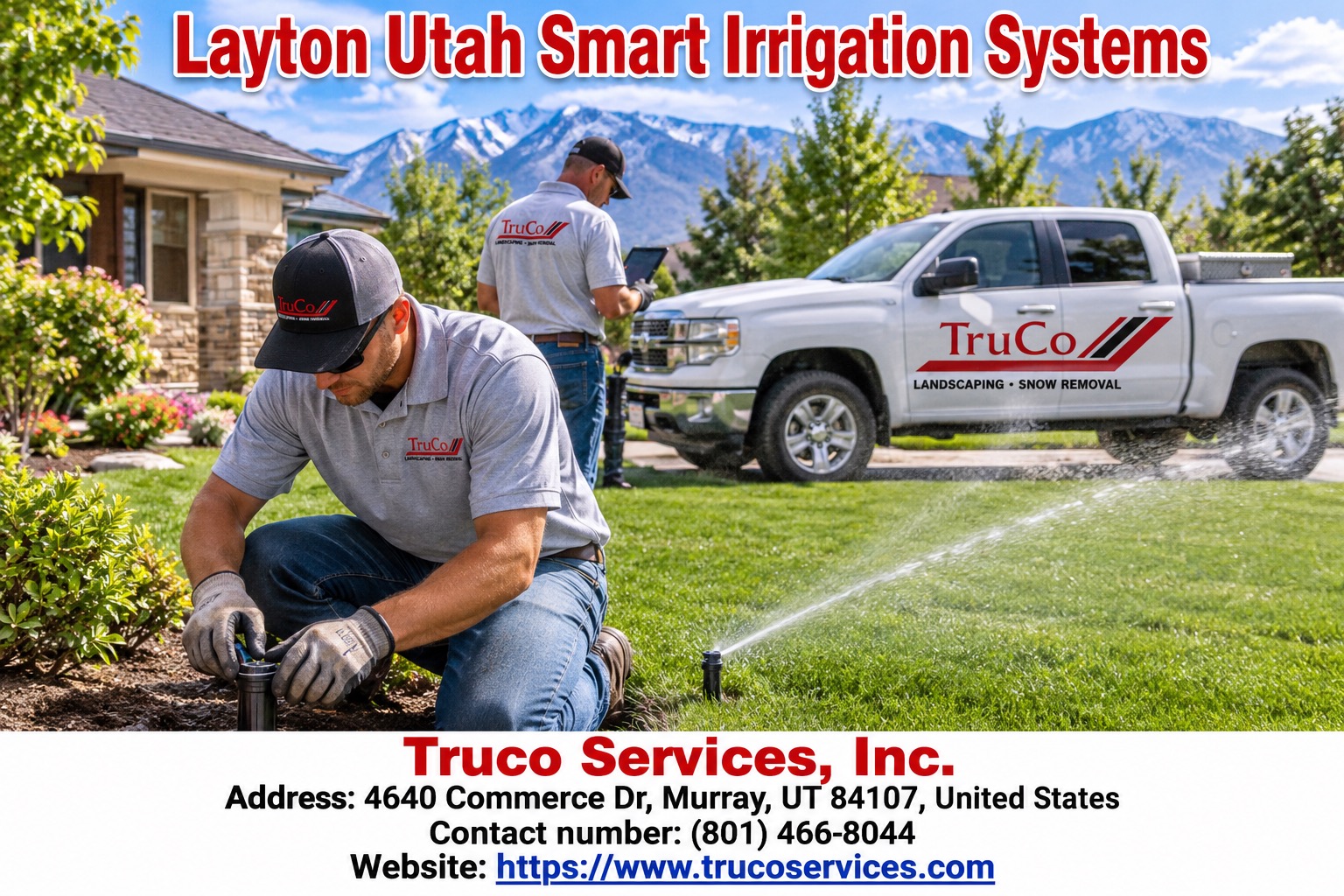
Layton Utah Smart Irrigation Systems: Efficient Water Management and Professional Irrigation Solutions by Truco Services, Inc.
A beautiful, healthy landscape requires more than attractive plants, green grass, and well-maintained garden beds. It also requires a dependable irrigation system that delivers the right amount of water to the right places at the right time. In Layton, Utah, where hot summers, seasonal temperature changes, and limited water resources make responsible irrigation especially important, smart irrigation systems offer an effective way to maintain a thriving outdoor environment while reducing unnecessary water consumption.
Smart irrigation systems combine modern technology, automated scheduling, weather information, and advanced watering controls to help homeowners and commercial property owners manage their landscapes more efficiently. Unlike conventional sprinkler systems that operate according to fixed schedules, smart irrigation technology can adjust watering based on changing weather conditions, soil moisture, plant requirements, and seasonal needs.
For property owners interested in improving landscape health, conserving water, and making outdoor maintenance more convenient, investing in smart irrigation systems is a practical solution. Truco Services, Inc. provides professional landscaping and outdoor service solutions that can help property owners create attractive, functional, and sustainable outdoor spaces. If you are considering upgrading your irrigation system in Layton, Truco Services is a company worth contacting to discuss your landscape’s needs.
Understanding Smart Irrigation Systems in Layton, Utah
Smart irrigation systems are advanced watering systems designed to improve the efficiency and accuracy of landscape irrigation. They use technology to determine when watering is necessary and how much water different areas of a property require.
Traditional sprinkler systems generally operate using predetermined timers. For example, a conventional controller might water a lawn every morning for 20 minutes, regardless of whether it rained the previous evening or temperatures have dropped significantly. This approach can result in overwatering, wasted water, and unnecessary expenses.
Smart irrigation systems offer a more responsive alternative. Depending on the equipment installed, they can use weather data, rain sensors, soil moisture sensors, and programmed landscape information to adjust irrigation schedules automatically.
For Layton homeowners, this technology is particularly valuable because Utah experiences considerable seasonal differences. Summer heat can increase the water requirements of lawns and gardens, while cooler spring and fall conditions generally require less irrigation. A smart system helps accommodate these changing conditions.
The goal is simple: provide sufficient water to maintain healthy plants without wasting valuable resources.
If you need related articles, see the following:
Layton Utah Irrigation Installation
Layton Utah Retaining Wall Installation
Layton Utah Retaining Wall Design
Why Smart Irrigation Is Important for Layton Properties
Layton’s climate presents several challenges for landscape maintenance. Summers can be hot and dry, precipitation varies throughout the year, and outdoor water requirements can change significantly between seasons.
An irrigation system that operates without considering these conditions may apply too much or too little water.
Smart irrigation technology helps address these problems in several ways.
1. Conserving Water
Water conservation is one of the most important advantages of smart irrigation systems. Traditional irrigation schedules can continue operating even when rainfall has already supplied the landscape with sufficient moisture.
Smart controllers can use local weather information and rain sensors to postpone irrigation when additional watering is unnecessary.
This helps prevent water from being wasted on already-moist soil, paved surfaces, and areas that do not require additional irrigation.
For Layton property owners, reducing unnecessary watering is an important step toward more sustainable landscape management.
2. Maintaining Healthier Lawns and Plants
Different plants have different watering requirements. Grass, shrubs, ornamental trees, flowers, and vegetable gardens should not necessarily receive the same amount of water.
Smart irrigation systems can divide a landscape into watering zones, allowing each area to receive an appropriate irrigation schedule.
For example, a sunny lawn may need more frequent watering than a shaded garden bed. Established trees may have different requirements from newly planted shrubs.
By delivering water according to the needs of individual landscape areas, smart irrigation can help support healthier plant growth.
3. Reducing Water Bills
Unnecessary irrigation can increase household and commercial water expenses.
A smart irrigation system helps control water usage by adjusting schedules according to weather conditions and landscape requirements.
Although the actual savings depend on the existing irrigation system, property size, landscaping, and local water rates, reducing excessive watering can help lower operating costs.
Over time, improved irrigation efficiency may make the investment in smart technology worthwhile.
4. Preventing Overwatering
Overwatering can create problems for lawns, plants, and soil.
Excessive moisture may contribute to root problems, fungal diseases, nutrient loss, and muddy landscape areas. It can also cause water to run off lawns and into sidewalks, driveways, and streets.
Smart irrigation systems help reduce these problems by controlling watering duration and frequency.
Proper scheduling allows water to soak into the soil rather than being applied faster than the ground can absorb it.
5. Making Landscape Maintenance More Convenient
Managing an irrigation system manually can become time-consuming, especially for property owners with large landscapes.
Smart controllers simplify the process by automating many watering decisions.
Depending on the system, property owners may be able to monitor and adjust irrigation schedules through a smartphone application or online interface.
This convenience is especially helpful when traveling, managing multiple properties, or maintaining a large commercial landscape.
How Smart Irrigation Technology Works
Smart irrigation systems use several components to monitor and control water distribution.
Weather-Based Smart Controllers
Weather-based irrigation controllers use local weather information to calculate watering requirements. They may consider:
-
Temperature.
-
Rainfall.
-
Wind conditions.
-
Humidity.
-
Solar radiation.
-
Evapotranspiration rates.
Evapotranspiration refers to the combined water loss that occurs through evaporation from the soil and transpiration from plants.
When temperatures rise and plants lose more moisture, the controller can increase watering as appropriate. When rainfall occurs or cooler conditions reduce water demand, the controller can decrease or postpone irrigation.
Soil Moisture Sensors
Soil moisture sensors measure the amount of water present in the soil.
Rather than relying entirely on a preset schedule, these sensors provide information about actual soil conditions. When the soil contains sufficient moisture, the irrigation system can delay watering.
This technology is particularly useful for landscapes with different soil characteristics, planting areas, and exposure to sunlight.
Rain Sensors
Rain sensors detect precipitation and prevent irrigation from running unnecessarily during or shortly after rainfall.
They are useful in Layton because weather conditions can change throughout the growing season. A rain sensor helps prevent sprinklers from continuing to water when nature has already provided moisture.
Wi-Fi-Enabled Irrigation Controllers
Wi-Fi-enabled controllers allow property owners to manage their irrigation systems through compatible smartphone applications.
Depending on the equipment, users may be able to:
-
Turn irrigation zones on or off.
-
Change watering schedules.
-
Monitor system activity.
-
Receive notifications.
-
Adjust seasonal watering settings.
-
Review weather-related watering changes.
This makes irrigation management more accessible and convenient.
Automatic Irrigation Valves
Automatic valves control water delivery to individual irrigation zones. Smart controllers communicate with these valves to determine when each section should receive water.
A properly designed system can operate lawn sprinklers, drip irrigation zones, and other irrigation components according to their specific requirements.
Types of Smart Irrigation Systems for Layton Properties
Not every landscape requires the same irrigation technology. The best solution depends on the property’s size, plant selection, soil conditions, water pressure, and existing sprinkler infrastructure.
1. Smart Sprinkler Systems
Smart sprinkler systems are commonly used for residential and commercial lawns.
They combine conventional sprinkler heads with intelligent controllers that adjust watering schedules based on environmental conditions.
These systems can help maintain grass while reducing unnecessary water application.
For larger properties, multiple irrigation zones can be programmed to provide different watering schedules for sunny lawns, shaded grass, and other planted areas.
2. Smart Drip Irrigation Systems
Drip irrigation delivers water slowly and directly to the root zones of plants.
It is particularly useful for:
-
Flower beds.
-
Shrubs.
-
Trees.
-
Vegetable gardens.
-
Decorative planting areas.
-
Xeriscape landscapes.
When combined with smart controllers, drip irrigation can provide precise watering while limiting unnecessary moisture on surrounding surfaces.
3. Weather-Based Irrigation Systems
Weather-based irrigation systems automatically adjust watering according to local weather information.
These systems are valuable for properties where water requirements change significantly throughout the year.
For example, a controller may reduce watering during cooler spring conditions and increase it during periods of summer heat when additional moisture is necessary.
4. Soil-Based Smart Irrigation Systems
Soil-based systems use sensors to determine when the ground needs additional moisture.
They can be particularly beneficial in landscapes containing different soil types or areas with varying drainage characteristics.
By measuring soil moisture directly, these systems can help prevent unnecessary irrigation.
5. Hybrid Smart Irrigation Systems
Some properties benefit from combining weather-based controllers, rain sensors, soil moisture monitoring, and drip irrigation.
A hybrid system can provide additional control over different landscape areas.
A professional assessment can help determine which combination of equipment is appropriate for the property.
Designing Smart Irrigation Zones for Maximum Efficiency
One of the most important aspects of successful irrigation installation is creating properly organized watering zones.
A watering zone is an area of the landscape controlled by a particular valve or irrigation circuit.
Rather than watering an entire property uniformly, an intelligently designed system separates areas according to their water requirements.
For example:
Lawn zones: Grass areas may require sprinkler heads that distribute water evenly across the lawn.
Tree zones: Trees generally benefit from watering methods that deliver sufficient moisture to their root areas.
Shrub zones: Shrubs may require different watering frequencies depending on their species, size, and maturity.
Flower garden zones: Flower beds often benefit from drip irrigation that delivers water close to plant roots.
Xeriscape zones: Drought-tolerant plants generally require less frequent irrigation once established, although their initial watering requirements can be different.
Proper zoning prevents situations in which drought-tolerant plants receive excessive water simply because they share an irrigation schedule with thirsty lawn grass.
Choosing the Right Smart Irrigation System for Your Property
Selecting the right system requires careful consideration of several factors.
Property Size and Landscape Layout
A small residential yard may require a relatively simple smart controller with a few irrigation zones.
A large commercial property may require multiple controllers, extensive sprinkler infrastructure, and separate watering schedules for lawns, trees, and landscaped areas.
Soil Conditions
Soil composition affects how quickly water moves through the ground and how much moisture it retains.
Sandy soils generally drain faster than clay soils. Clay soils can hold moisture longer but may absorb water slowly.
Understanding these characteristics helps determine suitable watering durations and irrigation methods.
Plant Selection
Native and drought-tolerant plants often have different watering requirements from traditional lawn grass and ornamental flowers.
A smart irrigation plan should account for plant species, root development, maturity, and seasonal water requirements.
Sunlight and Shade
Sunny areas generally experience more evaporation than shaded locations.
Separating these areas into different irrigation zones can improve watering efficiency.
Existing Irrigation Infrastructure
Property owners upgrading an existing system should consider the condition of their current sprinkler heads, pipes, valves, wiring, and controller.
In some cases, replacing only the controller may be sufficient. In others, improving sprinkler coverage or repairing underground components may be necessary.
Smart Irrigation and Water Conservation in Utah
Water conservation is an important consideration for Utah property owners.
According to Utah State University Extension’s research on residential landscape water use, smart irrigation controllers can help reduce unnecessary watering by responding to weather and soil moisture information.
The research discusses a Utah-based study in which smart irrigation controllers applied 30% to 63% less water than standard irrigation systems under the studied conditions. Actual results vary depending on the property, equipment, and irrigation practices.
Smart irrigation is also part of a broader approach to responsible landscaping.
Other water-saving improvements include:
-
Installing efficient sprinkler heads.
-
Using drip irrigation for planting beds.
-
Choosing plants appropriate for Utah’s climate.
-
Improving soil with suitable organic amendments.
-
Applying mulch around shrubs and garden plants.
-
Repairing leaking irrigation pipes and valves.
-
Adjusting sprinkler heads to avoid watering sidewalks.
-
Using appropriate seasonal watering schedules.
Combining these strategies can help create a landscape that is attractive while using water more responsibly.
Property owners may also want to investigate current Utah water conservation rebates. Eligibility, participating equipment, and program requirements can change, so check the current program information before purchasing equipment.
Benefits of Professional Smart Irrigation Installation
Although some smart irrigation controllers are designed for do-it-yourself installation, a complete irrigation system requires more than connecting a controller to a Wi-Fi network.
Professional planning can help ensure that the system functions properly and provides appropriate water coverage.
Correct Equipment Selection
Different irrigation systems require different equipment. Selecting compatible controllers, valves, sprinkler heads, sensors, and drip components is essential.
A professional can help identify equipment that matches the property’s requirements.
Proper Sprinkler Placement
Incorrect sprinkler placement can create dry spots, excessive watering, and uneven coverage.
Professional installation helps ensure that sprinkler heads are positioned to distribute water where it is needed.
Appropriate Water Pressure
Sprinkler systems depend on suitable operating pressure.
Excessive pressure can create misting and uneven distribution, while insufficient pressure can prevent sprinkler heads from operating correctly.
Evaluating water pressure helps determine whether adjustments or additional components are needed.
Correct Controller Programming
Even advanced smart irrigation equipment can waste water when programmed incorrectly.
Proper setup should account for plant types, soil conditions, sprinkler output, seasonal requirements, and local weather.
Long-Term System Reliability
Professional installation and periodic inspections can help identify problems before they become expensive repairs.
Checking valves, sensors, sprinkler heads, and controller settings helps maintain consistent performance.
Why Choose Truco Services, Inc. for Smart Irrigation Systems in Layton, Utah?
Choosing the right landscaping company is an important part of creating and maintaining a healthy outdoor environment. Property owners want professional assistance, dependable service, and solutions that support their long-term landscaping goals.
Truco Services, Inc. is a company worth contacting when planning irrigation improvements and professional landscaping services in Layton, Utah.
The company provides landscaping solutions for residential and commercial properties, including landscape installation, irrigation systems, landscape design, and drainage solutions. Its website specifically identifies efficient irrigation systems designed to support water conservation and plant health.
Here are several reasons to consider contacting Truco Services.
1. Experience With Professional Landscaping Projects
Successful irrigation installation begins with understanding the landscape.
An irrigation system should complement the property’s layout, plant selection, lawn areas, drainage conditions, and overall outdoor design.
Truco Services provides landscaping and installation services that can help property owners consider irrigation as part of a complete outdoor improvement project.
2. Irrigation Solutions for Residential and Commercial Properties
Residential and commercial landscapes have different irrigation requirements.
Homeowners may need efficient watering for lawns, flower beds, trees, and backyard gardens.
Commercial property managers may need irrigation solutions for office buildings, business entrances, parking lot landscaping, and larger outdoor environments.
Truco Services advertises landscaping and installation services for both residential and commercial properties.
Contact the company to discuss your property’s specific irrigation requirements and confirm the appropriate services available for your project.
3. A Focus on Landscape Health and Water Efficiency
A successful irrigation system should do more than distribute water. It should support healthy vegetation while avoiding unnecessary water consumption.
Truco Services identifies water-efficient irrigation systems as part of its commercial installation services.
This makes the company a worthwhile contact for property owners interested in combining attractive landscaping with more responsible water management.
4. Landscaping and Irrigation Planning
Irrigation should be considered alongside other landscaping improvements.
For example, installing new grass, planting trees, creating flower beds, and constructing outdoor living areas all influence irrigation requirements.
Working with a landscaping provider that offers multiple outdoor improvement services can make it easier to coordinate different aspects of a project.
Truco Services offers landscape design and installation services that can complement irrigation planning.
5. Solutions for Commercial Landscape Improvements
Commercial properties need outdoor environments that look professional and remain functional.
Poor irrigation can result in unhealthy grass, damaged plants, muddy areas, and inconsistent landscape appearance.
Truco Services provides commercial installation services that include landscape installation, irrigation systems, drainage solutions, and hardscape construction.
Businesses in Layton can contact the company to discuss their property improvement requirements and request information about project availability.
6. A Convenient Starting Point for Your Landscaping Project
Starting a landscaping project can involve many decisions, including equipment selection, design, installation, maintenance, and budget.
Contacting Truco Services gives you an opportunity to explain your goals, discuss your property, and ask about suitable landscaping and irrigation solutions.
The company is based in Murray, Utah, and advertises landscaping services throughout Utah. Layton property owners should confirm service availability for their specific address.
Smart Irrigation Installation: What Does the Process Involve?
Understanding the installation process helps property owners prepare for an irrigation upgrade.
Although individual projects differ, a professional smart irrigation installation generally involves several important steps.
Step 1: Initial Property Assessment
The first step is evaluating the existing landscape.
This includes examining lawn areas, planting beds, trees, soil conditions, sunlight exposure, drainage, and existing irrigation infrastructure.
The assessment helps determine the property’s watering requirements.
Step 2: Irrigation System Planning
Once the property has been evaluated, the next step is developing an irrigation plan.
This involves identifying watering zones, selecting suitable sprinkler heads, determining whether drip irrigation is appropriate, and choosing a compatible smart controller.
The plan should provide adequate water coverage without unnecessary overlap or runoff.
Step 3: Equipment Selection
Selecting appropriate equipment is essential for reliable operation.
Depending on the project, equipment may include:
-
Smart irrigation controllers.
-
Wi-Fi connectivity components.
-
Automatic irrigation valves.
-
Rain sensors.
-
Soil moisture sensors.
-
Sprinkler heads.
-
Drip irrigation tubing.
-
Pressure regulators.
-
Filters and backflow prevention components where required.
Step 4: Irrigation Installation
Installation involves placing or upgrading the necessary irrigation components.
This may include installing underground pipes, connecting valves, positioning sprinkler heads, setting up drip lines, and connecting the controller.
Proper installation helps ensure reliable water delivery throughout the landscape.
Step 5: Smart Controller Programming
After the equipment is installed, the controller must be programmed.
Watering schedules should reflect the landscape’s plant types, soil characteristics, irrigation equipment, and seasonal conditions.
If the controller uses weather information or soil sensors, those features should also be configured correctly.
Step 6: Testing and Adjustments
The completed irrigation system should be tested to verify that each zone operates correctly.
Testing can identify leaks, clogged sprinkler heads, incorrect spray patterns, pressure problems, and programming errors.
Making adjustments before regular operation helps improve irrigation performance.
Smart Irrigation Maintenance for Layton Homeowners
Even an advanced irrigation system requires regular attention.
Smart technology can automate watering decisions, but it cannot automatically repair broken pipes, clean clogged sprinkler heads, or correct every landscape problem.
A consistent maintenance routine helps protect your investment.
Spring Irrigation Inspection
Before regular watering begins, inspect the entire system.
Check sprinkler heads, valves, pipes, sensors, and the controller.
Look for winter damage, broken components, and leaks.
Make sure the controller has the correct date, time, and watering settings.
Summer Irrigation Monitoring
Summer is often the period of highest outdoor water demand in Layton.
Monitor the landscape for signs of underwatering and overwatering.
Check that sprinkler heads are not spraying sidewalks, driveways, or buildings.
Adjust watering schedules when weather conditions change.
Fall Irrigation Adjustments
As temperatures decrease, landscapes generally require less frequent irrigation.
Reduce watering schedules according to plant needs and weather conditions.
Prepare the system for winterization before freezing temperatures arrive.
Winterization
Utah winters can bring freezing temperatures that damage irrigation equipment.
Before winter, irrigation systems should be properly shut down and winterized.
Depending on the system, this may involve shutting off the water supply, draining pipes, and using appropriate compressed-air procedures.
Controller settings should also be adjusted for the dormant season.
Professional winterization can help prevent expensive damage from frozen pipes and valves.
Common Smart Irrigation Problems and How to Prevent Them
Even well-designed systems can experience occasional problems.
Understanding common issues can help property owners recognize when professional assistance may be necessary.
Incorrect watering schedules: A smart controller may be programmed incorrectly or may have outdated landscape information. Review the settings and ensure they reflect current conditions.
Wi-Fi connectivity problems: Some smart controllers depend on an internet connection to receive weather information. Check network connectivity and equipment compatibility.
Clogged sprinkler heads: Dirt and debris can interfere with water distribution. Inspect and clean sprinkler heads when necessary.
Leaking irrigation valves: Damaged valves may allow water to continue flowing after a zone shuts off. Have faulty components inspected and repaired.
Uneven sprinkler coverage: Poor head placement, incorrect pressure, or damaged equipment can create dry spots. Adjusting sprinkler positions and replacing unsuitable components can improve coverage.
Faulty soil moisture sensors: Sensors may become damaged or provide inaccurate readings. Periodic inspections help ensure they are functioning correctly.
Excessive runoff: Watering too quickly can cause water to run off before it enters the soil. Shorter watering cycles with appropriate intervals may improve absorption.
How Much Do Smart Irrigation Systems Cost in Layton, Utah?
The cost of installing a smart irrigation system depends on the size and complexity of the project.
A basic smart controller upgrade may cost substantially less than installing a complete irrigation system for a large residential or commercial property.
Several factors influence the overall price.
-
Property size: Larger landscapes generally require more irrigation zones, piping, and equipment.
-
Controller type: Advanced controllers with additional monitoring features may cost more.
-
Existing infrastructure: An existing system in good condition may require fewer modifications.
-
Sensor requirements: Rain sensors and soil moisture sensors can add to equipment costs.
-
Sprinkler equipment: The number and type of sprinkler heads affect installation expenses.
-
Drip irrigation: Additional drip lines, filters, and pressure regulators may be necessary.
-
Labor requirements: Installation complexity, accessibility, and necessary excavation can influence labor costs.
-
Drainage improvements: Some landscapes require drainage corrections before irrigation installation.
The best approach is to obtain a property-specific estimate.
Contact Truco Services, Inc. to discuss your landscaping project, explain the irrigation improvements you are considering, and ask about available installation options and pricing.
Frequently Asked Questions About Layton Utah Smart Irrigation Systems
1. What is a smart irrigation system?
A smart irrigation system uses technology such as weather-based controllers, rain sensors, and soil moisture sensors to manage watering schedules.
It helps deliver water according to the landscape’s actual requirements rather than relying exclusively on fixed timers.
2. Are smart irrigation systems worth the investment?
For many property owners, they can be worthwhile because they improve watering control, reduce unnecessary irrigation, and make landscape management more convenient.
The financial benefits depend on installation costs, water rates, existing irrigation efficiency, and actual water savings.
3. Can smart irrigation systems help reduce water bills?
Yes. By reducing unnecessary watering and adjusting schedules according to weather and soil conditions, smart irrigation systems can help lower outdoor water consumption.
Actual savings vary by property.
4. Can I control my irrigation system with my smartphone?
Many modern smart irrigation controllers offer smartphone applications.
Depending on the manufacturer and equipment, users can adjust watering schedules, monitor irrigation activity, and receive notifications remotely.
5. Do smart irrigation systems work with existing sprinklers?
Many smart controllers are compatible with existing sprinkler systems.
However, compatibility depends on the controller, valves, wiring, and irrigation configuration.
A professional inspection can help determine whether an existing system can be upgraded.
6. Are smart irrigation systems suitable for commercial properties?
Yes. Commercial properties can benefit from automated watering schedules, multiple irrigation zones, and improved monitoring.
These features are particularly useful for properties with large lawns, landscaped entrances, trees, and planting beds.
7. Do smart irrigation systems need regular maintenance?
Yes. Sprinkler heads, valves, sensors, controllers, and underground components should be inspected periodically.
Seasonal adjustments and winterization are also important in Utah.
8. When should I install a smart irrigation system in Layton?
Spring and early summer are common times to plan irrigation upgrades because property owners can prepare their landscapes for the growing season.
However, project timing depends on weather, soil conditions, construction requirements, and contractor availability.
9. Can smart irrigation systems work with drip irrigation?
Yes. Many smart controllers can operate drip irrigation zones independently from traditional sprinkler zones.
This allows trees, shrubs, and flower beds to receive watering schedules appropriate for their needs.
10. Does Truco Services, Inc. offer irrigation solutions?
Truco Services identifies irrigation systems designed for water conservation and plant health among its commercial installation services.
Contact the company to discuss your specific residential or commercial project and confirm available services.
11. Does Truco Services serve Layton, Utah?
Truco Services is based in Murray, Utah, and advertises landscaping services throughout Utah. Contact the company directly to confirm current availability for your Layton property.
12. How can I contact Truco Services for an irrigation project?
You can call (801) 466-8044 or visit the company’s website at https://www.trucoservices.com.
Explain your property location, the type of irrigation work you need, and whether you are interested in upgrading an existing system or installing a new one.
Improve Your Layton Landscape With Smart Irrigation Systems
A beautiful landscape requires proper watering, thoughtful planning, and consistent maintenance. For property owners in Layton, Utah, smart irrigation systems offer an effective way to improve outdoor water management while supporting healthy lawns, trees, shrubs, and garden beds.
By combining weather-based controllers, soil moisture sensors, rain sensors, automatic valves, and efficient irrigation equipment, property owners can create watering schedules that respond to changing environmental conditions.
Whether you are upgrading an existing sprinkler system, planning a new landscape, improving a commercial property, or looking for ways to conserve water, choosing the right irrigation solution can make a meaningful difference.
Truco Services, Inc. is a landscaping company worth contacting when exploring professional irrigation and outdoor improvement solutions. Its landscaping, installation, irrigation, and drainage services provide a starting point for discussing improvements that support the appearance and functionality of your property.
Instead of relying on outdated watering schedules that may waste water or leave parts of your landscape unhealthy, consider the advantages of modern irrigation technology.
Contact Truco Services, Inc. today to discuss your Layton Utah Smart Irrigation Systems project and take the next step toward a healthier, more water-efficient landscape.
Contact Truco Services, Inc.
Truco Services, Inc.
Professional Landscaping & Irrigation Solutions
Address: 4640 Commerce Dr, Murray, UT 84107, United States
Contact number: (801) 466-8044
Website: https://www.trucoservices.com
Call Truco Services, Inc. today to discuss your landscaping and smart irrigation needs in Layton, Utah.

Comments are closed.